Agents Can Talk to Each Other. They Still Can't Remember Each Other.
By Soumya Ranjan Sahoo · · 6 min read
#agentic-ai#mesh-memory-protocol#multi-agent-systems#AI-research
MCP solved agent-to-tool. A2A solved agent-to-agent. The layer nobody's built yet is memory-to-memory — and three separate research directions (Mesh Memory Protocol, multi-agent computer architecture, Portable Agent Memory) are converging on the same missing primitive: consistency, not retrieval.
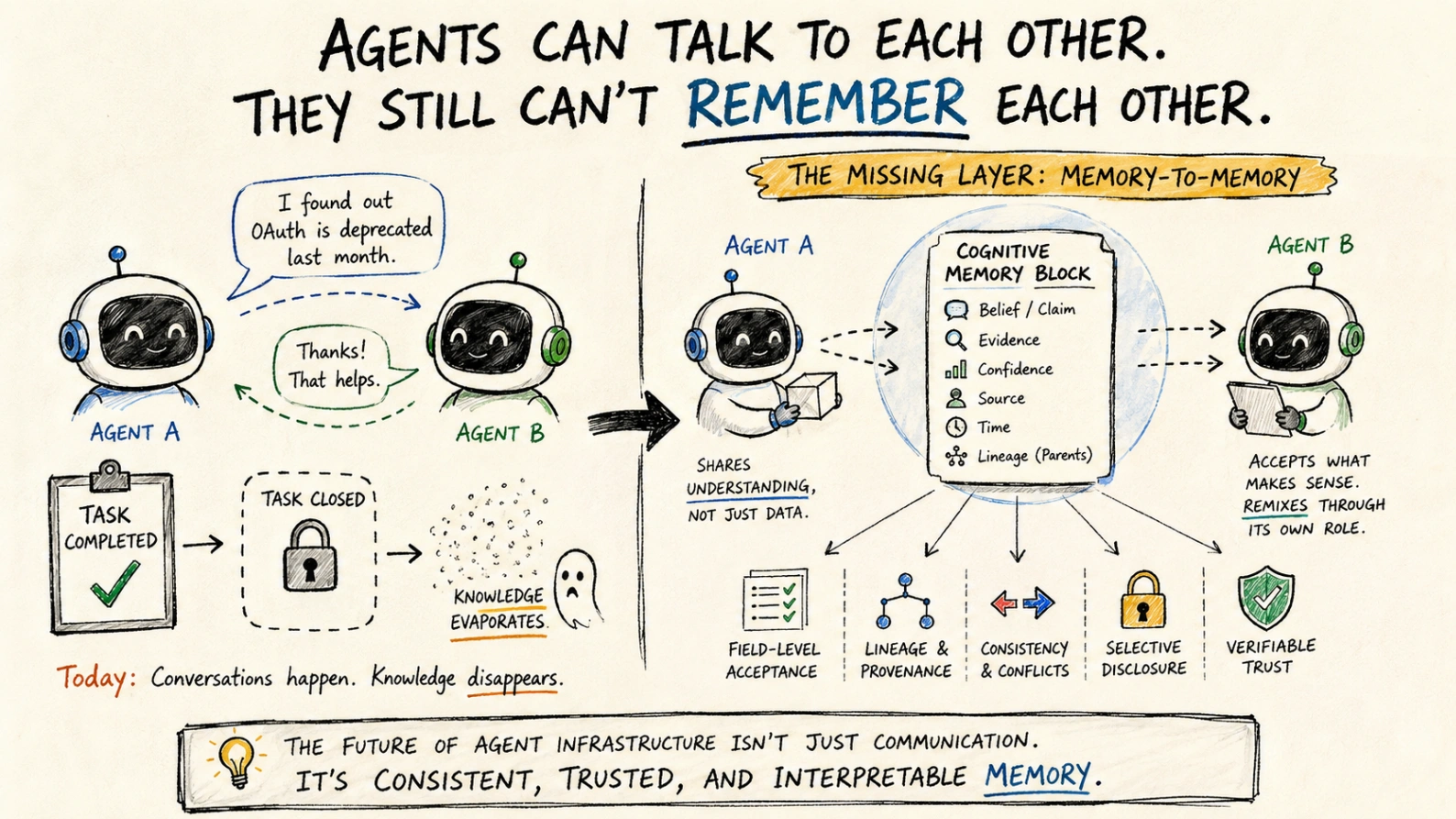
Agents Can Talk to Each Other. They Still Can't Remember Each Other. Cold Open Two agents finish a task together. One of them figured out something true and useful along the way — say, that a particular API deprecated OAuth last month. The task ends. The Task object closes. And that knowledge just... evaporates. Not because anyone deleted it. Because nothing ever defined where it was supposed to go. We've spent two years building protocols for agents to talk to each other and call each other's tools. We have not spent nearly enough time building protocols for what an agent is allowed to keep. Thesis The interesting frontier in agent infrastructure isn't communication anymore. It's state transfer. MCP solved agent-to-capability. A2A solved agent-to-agent. Both are, at their core, request/response layers — one agent asks, another agent answers, and the answer is consumed once. What's missing is the layer above both of them: memory-to-memory. Not "here's a message," but "here's a piece of my accumulated understanding — decide for yourself what to do with it." That distinction sounds academic until you watch what happens without it. Wrong Version First The naive way to solve "agents forget things across sessions" is to bolt on a vector database. Every agent writes its outputs into a shared store; every agent retrieves relevant chunks before acting. This is what most multi-agent stacks do today, and it feels like progress because retrieval accuracy goes up. But a vector store doesn't know anything about belief. It just knows about similarity. Ask it "what do we currently know about X" and it hands you three semantically related fragments with no indication of which one is current, which one is a guess, which one was written by an agent with no authority to make that claim, and which one has already been contradicted twice. You've replaced "the agent forgot" with "the agent now has three conflicting memories and no way to tell them apart." That's not a memory system. That's a bigger, more confident-sounding junk drawer. Real Argument Three independent research directions are converging on the same missing abstraction, and it's worth naming precisely because none of them talk about it as "better RAG" — they talk about it as consistency. Mesh Memory Protocol proposes a semantic layer that sits above tool-access and task-delegation protocols entirely. Its core primitives are worth internalizing: - Cognitive memory blocks — a fixed structure for a unit of knowledge, not a raw text blob - Field-level acceptance — the receiving agent can accept part of a memory object without swallowing the whole thing - Lineage — every memory carries parent/ancestor relationships, so you can trace where a belief came from - Remixing — the receiver reinterprets incoming knowledge through its own role and epistemic state, rather than importing it verbatim That last point is the one people will skip past and shouldn't. It quietly redefines what "sharing memory" even means. Memory transfer is not context transfer. A Security Agent and an Operations Agent receiving the same fact should not end up with identical memories — they should end up with different interpretations of the same underlying evidence, shaped by what each of them is responsible for. Running in parallel, a separate research direction reframes multi-agent memory as a computer-architecture problem — literally borrowing the vocabulary of shared vs. distributed memory, cache sharing, and memory hierarchies. That framing lands on the exact same gap from the systems side: nobody has defined consistency semantics or structured access control for agent knowledge. It's the same wall, approached from computer science's oldest problem instead of NLP's newest one. And a third proposal, Portable Agent Memory, attacks it from the security angle: Merkle-DAG provenance, capability-based disclosure, and cryptographic verification, so a memory object can be proven to have come from where it claims to have come from, and disclosed selectively rather than dumped wholesale. Semantics. Systems. Security. Three different vocabularies circling the same primitive: agent knowledge needs identity, lineage, and the right to disagree with itself. Structural Device Picture the stack as it exists today versus what these three papers are quietly proposing: The left column answers "what's semantically close to my query." The right column answers a completely different question: "what do we currently believe, why do we believe it, who established it, and what evidence could overturn it?" Everything below "retrieve" on the right side is new vocabulary borrowed from distributed systems — because that's genuinely what this is now. Honest Counterpoint None of this is shipped, standardized, or battle-tested. Mesh Memory Protocol and Portable Agent Memory are proposals, not adopted specs — there's no equivalent of A2A's v1.0.1 release history behind them yet. And there's a real risk in overengineering here: most teams building agents today don't have a multi-agent-with-contradictory-sources problem. They have a "my one agent forgets what happened yesterday" problem, and a full provenance-and-lineage system is a lot of ceremony for that. Field-level acceptance and Merkle-DAG provenance solve a coordination problem that only shows up once you have multiple independent, semi-trusted agents writing to a shared belief space — which is still a minority of production systems in mid-2026. Adopting this vocabulary before you have the problem is its own kind of premature abstraction. Rule of Thumb If your agents only ever read their own memory, a vector store is fine. The moment a second agent — with a different role, different access, or different trust level — needs to inherit a belief rather than just retrieve a fact, you've crossed into territory a vector database was never designed for, and you need to start asking who said this, when, with what confidence, and what would change their mind. Reflective Close Last week the open question in this space was "what is the agent allowed to do?" — the whole authorization-and-tool-access conversation. This week the question quietly shifted underneath it: "what is the agent allowed to remember from what happened?" That's a more permanent question than it sounds. Authorization scopes decay the moment a task ends. Memory doesn't — it becomes institutional state, carried forward into every future decision an agent makes on your behalf. Get authorization wrong and an agent does the wrong thing once. Get memory consistency wrong and an agent quietly believes the wrong thing forever, and passes that belief on to every agent it talks to next.