Building ResumeOS: An AI-Native Operating System for Job Applications
By Soumya Ranjan Sahoo · · 18 min read
#AI#Agentic AI#Multi-Agent Systems#Software Architecture#Product Engineering
ResumeOS is an AI-native job application intelligence system that combines candidate memory, job intelligence, evidence matching, bounded AI agents, resume strategy, and an interactive editing workflow into one persistent system.
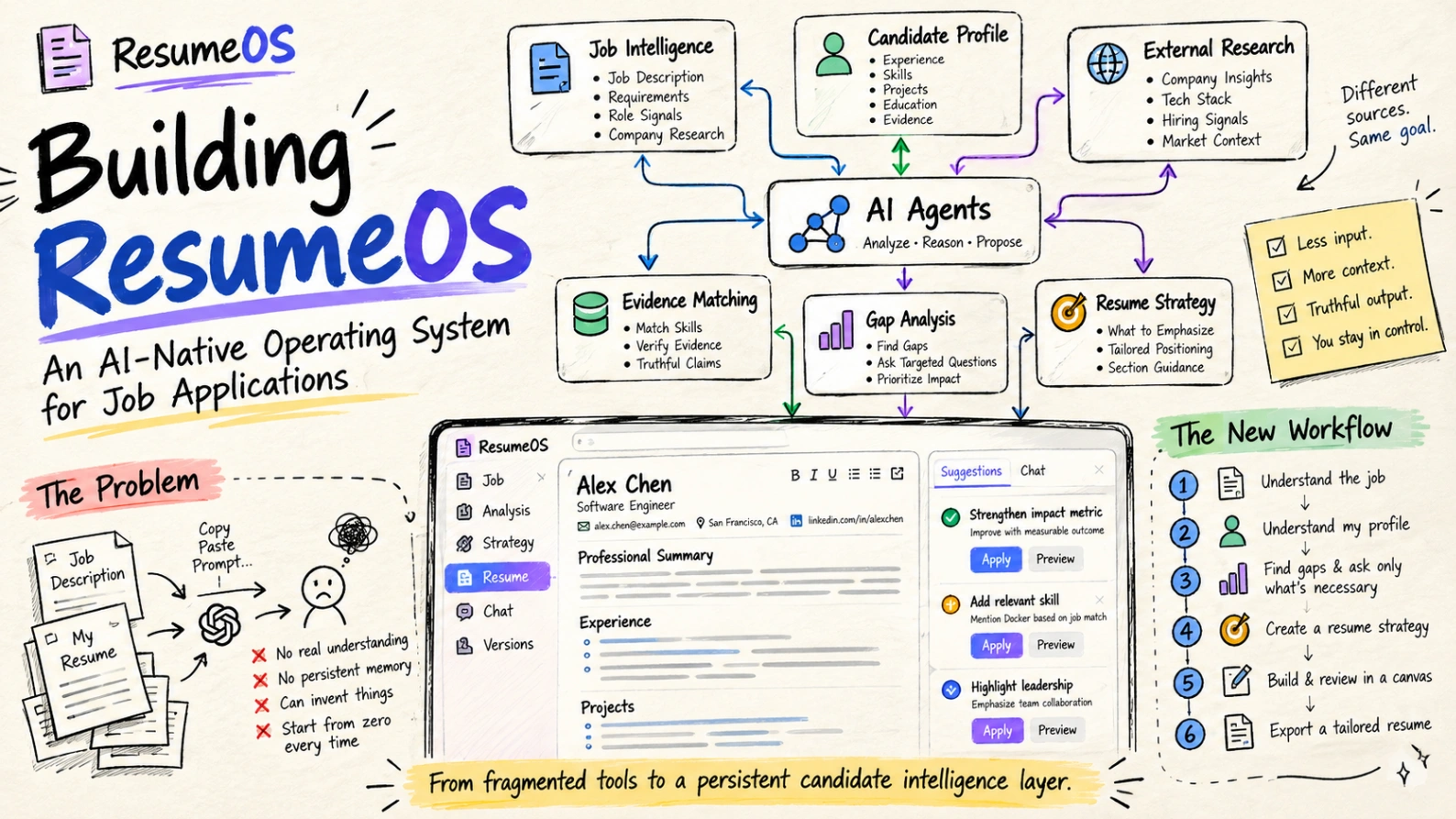
Building ResumeOS: An AI-Native Operating System for Job Applications Most resume tools start with a document. ResumeOS starts with a question: > What would it take for an AI system to actually understand a candidate and a job before helping create an application? That distinction changes almost everything. A conventional AI resume generator takes some text, sends it to an LLM, asks it to rewrite the content, and returns a document. That works for generating text. But building a genuinely useful job-application system requires much more. The system needs to understand: - who the candidate is - what they have actually done - what evidence supports those claims - what a particular job requires - what the company is looking for - where the candidate has strong evidence - where information is missing - what should be emphasized - what should not be claimed - how changes affect previous versions - and what the user has manually decided That is the problem I am exploring with ResumeOS. --- What is ResumeOS? ResumeOS is an AI-powered personal job-application intelligence system. The first major capability is highly tailored resume creation. The intended experience is simple: But behind that simple experience is a much more structured system. ResumeOS is designed around a persistent candidate intelligence layer rather than treating every resume request as an isolated conversation. The long-term idea is that my career information should not have to be reconstructed every time I apply for a new job. The system should progressively understand me. And every application should build on that understanding. --- The Problem With Today's AI Resume Workflow The common workflow looks something like this: It is useful. But it has several fundamental limitations. 1. The job is treated as text A job description contains much more than keywords. There are signals about: - responsibilities - required technologies - seniority - expected ownership - domain knowledge - collaboration - business context - engineering expectations Simply extracting keywords doesn't produce a real understanding of the opportunity. 2. The candidate is treated as a document A resume is not the candidate. A candidate may have: - projects that aren't currently on the resume - experiences that were compressed into one bullet - certifications - technical skills - measurable achievements - previous work - domain knowledge - evidence scattered across multiple documents If the system only sees the current resume, it loses much of that context. 3. AI can invent things This is one of the most dangerous problems. A language model is optimized to generate plausible language. A resume needs to generate truthful claims. Those are not the same objective. If a job requires Kubernetes and the candidate has Docker experience, a naive system might generate: > "Designed and deployed Kubernetes-based production infrastructure." That sounds great. It is also potentially completely false. ResumeOS therefore treats factual grounding as a first-class architectural concern. 4. Every application starts from zero If the candidate applies to ten jobs, the system shouldn't behave as if it has never met the candidate nine times before. The candidate profile should persist independently from individual resumes. --- The Core Idea: Candidate Intelligence The most important design decision in ResumeOS is separating the candidate from the resume. A resume is a representation of a candidate for a particular opportunity. It is not the canonical source of truth. Conceptually: This creates an important separation. The candidate profile answers: > Who is this person? The job intelligence layer answers: > What does this opportunity require? The evidence layer answers: > What can we actually support? The resume strategy answers: > What should we emphasize for this particular opportunity? And the resume itself answers: > How should that strategy be presented? --- ResumeOS Is Not a Resume Generator This distinction is central to the project. ResumeOS is not intended to be: - a generic AI writer - a chatbot with a resume template - an ATS keyword stuffing tool - a document editor with an AI button - an autonomous black box - a system that invents experience to match a job Instead, it is designed as a structured application intelligence platform. The product principle is: > Less input. More context. Better evidence. More control. More iteration. More memory. Less fabrication. --- The Job Intelligence Pipeline When a user provides a job URL or job description, ResumeOS doesn't immediately ask an LLM to "write a resume." First, it builds a structured understanding of the opportunity. The conceptual pipeline is: This matters because the original job posting can change. A snapshot allows the application to preserve the state of the opportunity at the time the analysis was performed. The system can then reason about things such as: - required skills - preferred skills - responsibilities - role signals - seniority - technical expectations - relevant domain signals Instead of passing an enormous blob of text to every agent, the application can provide structured job context. --- Understanding the Candidate The second side of the system is the candidate. ResumeOS maintains a persistent candidate profile containing structured information about the user. But even here, there is an important distinction between a fact and the evidence supporting that fact. For example: The system should know not only: > "The candidate knows Python." but also: > "Why do we believe this?" That provenance becomes extremely important when generating resume content. ResumeOS therefore distinguishes different sources of candidate information, including user-provided information, uploaded documents, imported information, user-confirmed AI extraction, public external information, and system-derived information. External information can provide context. It cannot magically become proof that the candidate performed the work. --- Evidence Before Generation This is one of the most important principles behind ResumeOS. Before generating a claim, the system should be able to answer: > What evidence supports this? Imagine a job requires: The candidate might have evidence for: The system should not simply transform every requirement into a resume bullet. Instead, it should map the job requirements against actual candidate evidence. That enables a much more useful question: > Where is the strongest truthful intersection between this candidate and this opportunity? --- Gap Analysis Once the job and candidate are understood, ResumeOS can identify information gaps. For example: The goal is not to ask the candidate twenty questions before generating anything. The system should ask only when the missing information could materially affect the application. For example: > "You mentioned building an API with FastAPI. Did you deploy it using Docker?" is much more useful than: > "Tell me more about your technical experience." The system should maximize information gained per question. --- A Different Approach to AI Agents ResumeOS uses multiple bounded AI agents. But the goal isn't to build an impressive swarm of autonomous agents. The goal is controlled specialization. The architecture includes a central Resume Agent / orchestrator with bounded specialists such as: Each agent has a specific responsibility. This is important because an agent that understands a job should not automatically have permission to modify the candidate profile. An agent that writes resume content should not be able to directly update the database. An agent should reason. The application should decide. --- The Most Important Boundary The architectural rule can be summarized in one sentence: > Agents reason. Domain services decide and persist. For example, imagine an agent concludes: That should not immediately become: Instead: This boundary makes the system much easier to audit, test, reproduce, and trust. It also prevents an LLM from becoming the accidental owner of application state. --- Resume IR: The Document's Source of Truth Another important architectural decision is introducing a Resume Intermediate Representation, or Resume IR. Instead of treating generated Markdown, HTML, DOCX, or LLM output as the canonical resume, ResumeOS stores a structured representation. Conceptually: This gives the system something extremely valuable: a stable representation of the resume that software can reason about. The UI can render it. The AI can propose changes to it. The DOCX renderer can compile it. The user can edit it. But none of those representations becomes the canonical source. --- AI Changes Become Patches This leads to another important concept. The AI shouldn't simply regenerate the entire resume every time. Instead, AI modifications can be represented as structured patches. For example: The system can then validate: 1. Is the patch structurally valid? 2. Does the target exist? 3. Does the operation follow business rules? 4. Is the generated claim evidence-backed? 5. Has the underlying document changed since the patch was created? 6. Does the resulting Resume IR remain valid? Only after those checks should the change become part of a committed version. This makes AI editing much closer to software engineering than to text generation. --- Human + AI Collaboration ResumeOS is intentionally not a black box. The user remains the final authority over factual candidate information. The ideal interaction is: Manual edits are authoritative. If a user changes something in the resume, a later AI generation should not silently overwrite it. This is a surprisingly important product requirement. AI should accelerate the candidate. It should not fight the candidate. --- The Application Workspace The main workspace brings several pieces together: The idea is that users shouldn't have to jump between five different tools. The job, reasoning, resume, conversation, and history should exist in one application context. --- Versioning Is a First-Class Concept Every application should be reproducible. That means the system needs to preserve the context from which a resume was created. A resume version can reference things such as: This creates a history of how the application evolved. Instead of: the system understands versions as actual domain objects. That enables: - comparison - rollback - auditing - reproducibility - experimentation - safe AI iteration --- Research Is Treated as Untrusted Input ResumeOS may eventually use external information to understand companies, roles, hiring signals, and public context. But external research is fundamentally different from candidate evidence. For example: does not imply: The architecture therefore keeps external research separate from candidate truth. Research records can retain: - source URL - source type - retrieval time - extracted information - relationship to conclusions This distinction is essential for preventing accidental fabrication. --- Why I Chose a Structured Architecture It would be much easier to build ResumeOS as: And honestly, that would probably produce a working demo much faster. But it would also create problems very quickly. Where does candidate truth live? What happens when the AI hallucinates? How do we know why a bullet was generated? How do we preserve manual edits? How do we compare versions? How do we reproduce an old application? How do we prevent one agent from modifying unrelated state? How do we know whether an external fact came from a company website or the candidate? Those are not prompt-engineering problems. They are software architecture problems. That's why ResumeOS is intentionally designed as a structured application platform with bounded AI components rather than a single LLM workflow. --- The Architecture At a high level, the system is organized into several layers: The architecture deliberately separates: - domain state - application workflows - AI reasoning - persistence - external research - document rendering - user interface That separation is what allows the AI layer to evolve without turning the entire application into an unpredictable LLM workflow. --- The End-to-End Flow Putting everything together, the ResumeOS application loop looks like this: The interesting part is that the final document is almost the last step. The real product is everything that happens before it. --- Designing for Trust Resume generation has an unusual requirement. The output can be persuasive without being truthful. That means "good writing" is not enough. ResumeOS is therefore built around several trust principles: Evidence over inference If the system doesn't have evidence, it shouldn't silently invent it. Provenance over ambiguity The system should know where information came from. User authority over AI authority The candidate has the final say over their own factual information. Versioning over overwriting Important changes should create reversible versions. Structured changes over blind regeneration AI should propose controlled modifications rather than repeatedly replacing entire documents. Transparency over false confidence When information is uncertain, the system should surface that uncertainty. These principles are as important to the product as the AI models themselves. --- What Makes ResumeOS Interesting to Me The resume is almost a byproduct. The deeper idea is a persistent personal career intelligence layer. Imagine building your candidate profile once. Over time, ResumeOS could understand: Then different applications can be generated from that persistent knowledge. One job might emphasize: Another might emphasize: The underlying candidate doesn't change. The application strategy does. That is a much more powerful abstraction than "generate me a resume." --- The Long-Term Vision The first version of ResumeOS is focused deliberately. The immediate goal is: > Take a job opportunity and help the candidate produce the strongest truthful, tailored, polished resume with minimal effort. But the architecture leaves room for a much broader system. The same candidate intelligence layer could eventually support: The resume becomes one interface into a much larger personal career system. --- What ResumeOS Is Not Trying to Build Yet A good product architecture also needs boundaries. The initial system intentionally does not attempt to become: - an automatic job application bot - an automatic recruiter outreach system - an interview scheduling platform - a hiring probability predictor - a guaranteed ATS scoring engine - a social career network - a generic career chatbot - a resume template marketplace Those are separate product problems. The first objective is much narrower: Understand the opportunity. Understand the candidate. Build the application intelligently. --- Building ResumeOS as an Engineering Experiment For me, ResumeOS is also an exploration of a broader question: > What does software architecture look like when AI becomes a reasoning component inside a traditional application rather than the application itself? That question affects everything. Instead of: the architecture becomes: That pattern is useful far beyond resumes. It can apply to: - research systems - coding assistants - financial workflows - enterprise copilots - document intelligence - customer support - planning systems - internal business automation The interesting engineering challenge isn't simply making an LLM capable of doing something. It is making the overall system reliable when the LLM is capable of doing many things. --- Where the Project Stands ResumeOS is currently being designed from the architecture outward. The project has explicit specifications for: - product vision - engineering rules - system architecture - domain model - data model - agent architecture - resume representation - API contracts - design - implementation phases The goal is to reduce architectural drift as implementation progresses. That means the coding agent isn't supposed to invent the product while building it. The product model comes first. Implementation follows the model. This is particularly important for AI-native software because it is very easy to build something that looks impressive in a demo while quietly violating the underlying product assumptions. --- Final Thoughts I started thinking about ResumeOS as a better way to generate resumes. The more I designed it, the more I realized that the resume isn't really the interesting part. The interesting part is the intelligence behind it. A candidate has a body of experience. A job has a set of requirements. Evidence connects the two. AI can reason about that relationship. Software can preserve the resulting state. And the user remains in control. That leads to a simple mental model for ResumeOS: The goal isn't to make AI write a better resume. The goal is to make the entire process of turning real experience into a relevant application more intelligent, grounded, and repeatable. And that's what I'm building with ResumeOS.