The Shadow Organization: Designing an AI-Native Team of One (Plus Four)
By Soumya Ranjan Sahoo · 10 min read
#agentic-engineering#solo-founder#product-strategy
Why I stopped building a multi-tenant AI agent platform and started building a four-agent shadow organization for RiteLabs instead — the philosophy, the rejected designs, and the architecture that survived four rounds of review.
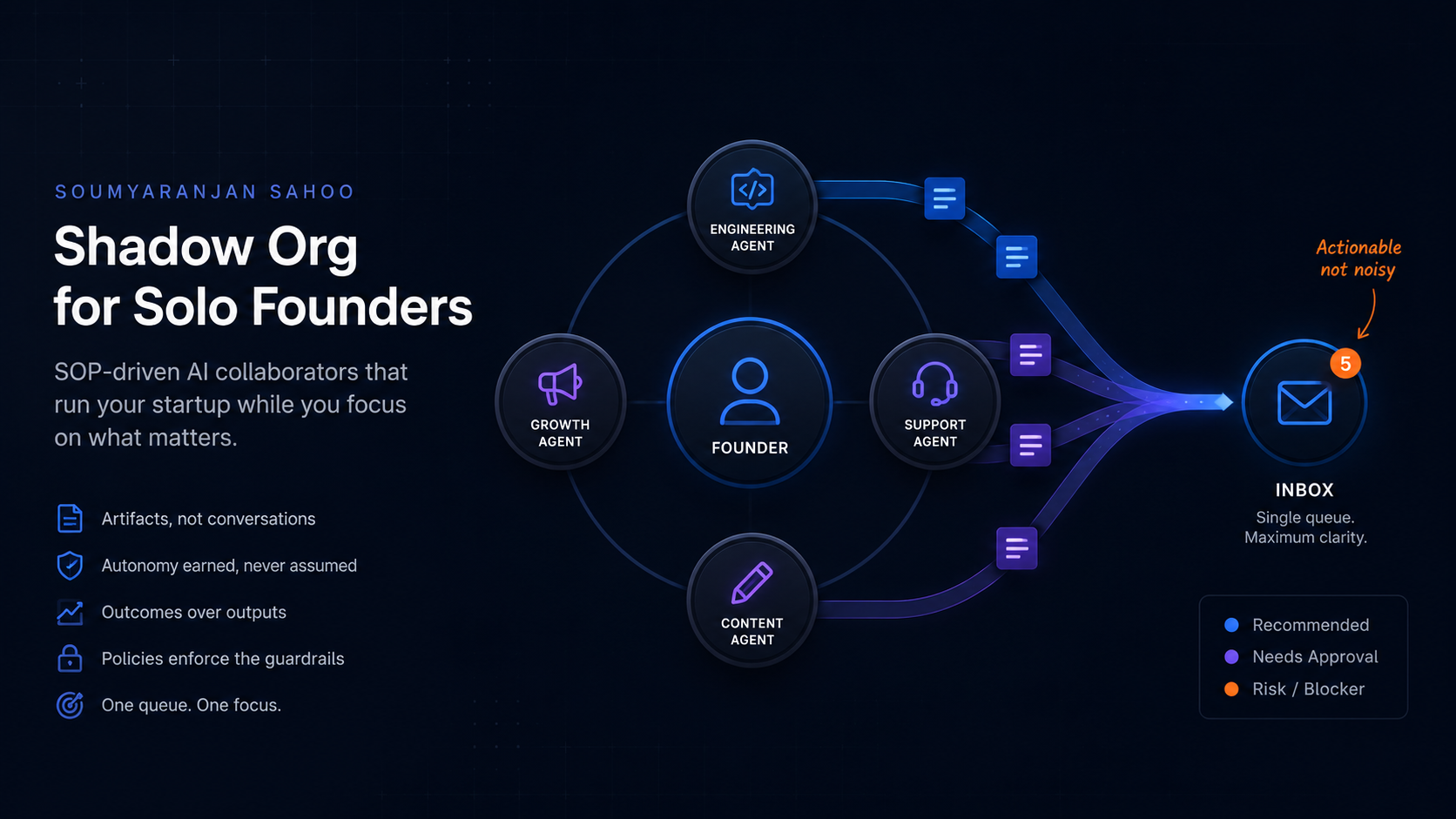
The Shadow Organization: Designing an AI-Native Team of One (Plus Four) For the last year, running RiteLabs has meant wearing every hat on the same day: shipping a Kotlin feature for RITE POS in the morning, drafting a LinkedIn post for SysLab at lunch, triaging a support ticket for Rite Habit Tracker in the evening, and somehow also finding twenty minutes to think about what to build next. None of those tasks are individually hard. Doing all of them, every week, without dropping one, is the actual failure mode of a solo founder — and it's the one that was quietly costing RiteLabs growth. This post is about the system I designed to fix that — not by replacing my judgment, but by removing the coordination tax around it. TL;DR - I don't need an AI company. I need an AI bench — a small, flat set of domain-expert agents that keep product, marketing, growth, and support moving while I'm heads-down in one of them. - The design went through four real revisions, and the most important work wasn't adding capability — it was rejecting the multi-tenant SaaS shape, the fake org hierarchy, and a "campaigns" layer that would've duplicated data I already had. - The whole system collapses to one rule: every agent's output lands in one ranked, capped queue — never six separate inboxes. - Autonomy is earned per-procedure, not assumed per-agent, and a fixed list of actions can never execute without my approval, no matter how much trust the system has earned. The wrong question I started with My first instinct was to build something like the managed AI-agent platforms now selling "an organization run by AI agents" to other companies — an org chart of AI employees, a CEO agent delegating to a CMO agent delegating to specialists, a task board, 1,000+ integrations. It's a legitimate product category. It was also completely the wrong shape for what I actually needed. That platform pattern exists to solve a problem I don't have: multiple human approvers, each with limited context, needing structure to coordinate with each other. I'm the only approver that will ever exist in this system. A CEO-agent "delegating" to a CMO-agent who "delegates" further is three LLM calls and two layers of latency to do what one well-scoped agent could do directly. Hierarchy is a solution to a coordination problem between humans. I don't have that problem. I have a bandwidth problem. Reframing it that way — from "AI company" to "founder exocortex" — changed almost every design decision downstream. The philosophy, in three rules 1. One queue, not N inboxes. The single biggest risk in a system like this is that it quietly becomes more to manage than doing everything myself. Four agents each producing their own stream of drafts, alerts, and suggestions is four new things to check — which is worse than zero things, because now I'm also deciding which inbox to open first. Every agent's output — a PRD draft, an enriched lead list, a drafted support reply, a competitor alert — lands in one ranked queue. I never "check in" on an agent. I clear one list. 2. Artifacts, not conversations, are the unit of work. It's tempting to let agents talk to each other — a PM-agent negotiating with an Eng-agent in a hidden thread. I rejected that early and I'd reject it again. If a handoff happens in a chat log, I lose the ability to intercept it mid-decision and I lose an inspectable record of why something got built. Instead, every agent produces a written artifact — a PRD, a launch note, a postmortem — in a shared knowledge base, and the next agent's job is explicitly "read this document, produce that document." Slower to feel magical. Far easier to trust and to debug. 3. Autonomy is earned, per procedure, with data — not assumed, per agent, on faith. I didn't want to decide up front which parts of this system get to run unattended. I wanted the system to prove it. Every recurring workflow starts in Assist mode — the agent drafts, I approve everything. Only after enough executions with a low edit-rate does a specific procedure get promoted to Controlled — it initiates on schedule, but output still queues for approval. A narrow third tier, Delegated, exists only for actions where the irreversible decision was already made upstream (publishing a post I already approved is not a new decision — it's executing an old one). And underneath all three tiers sits a fixed list of actions — deploying code, sending money, publishing publicly, replying to an angry customer — that can never execute without a logged human approval, regardless of how much trust the system has earned. That list is enforced in code, not in a prompt. The decisions that didn't survive review The most useful part of building this wasn't adding ideas — it was killing the ones that sounded good and weren't. Three, specifically: Department-head agents. An early draft had a Marketing lead synthesizing output from a Growth sub-agent, an SEO sub-agent, and a Social sub-agent before it reached me. In a real company, a department head exists partly to manage people and negotiate scarce resources against other departments. None of that exists here. A department head that just relays its reports' output upward is pure latency. Cut. A "Strategic Campaign" layer between company objectives and growth plans. This one took an extra round to catch. The proposal was a four-layer hierarchy — Objectives → Campaigns → Growth Plans → Tasks — to capture the idea that marketing should think in terms of a 6-week push toward a target, not a generic content calendar. The intent was right. But my Growth Plan object already had named, time-boxed phases with targets and tactics — a Campaign would have been the same data modeled a second time, with its own lifecycle to keep in sync. I kept the behavior (agents now think in terms of "advance the active campaign phase," not "produce today's content") and rejected the new object — the phases live inside the Growth Plan instead. 14 standing agents on day one. The original brainstorm had a full corporate roster: PM, UX, Sales Rep, QA Engineer, DevOps, Business Analyst, Finance Assistant, and more. A real startup doesn't hire fourteen people before product-market fit. Standing up a persistent agent — its own prompt, its own memory, its own tool scope — for a role that would fire twice a month is overhead dressed up as capability. The roster locked at four: Chief of Staff, Product & Engineering Assistant, Growth & Marketing, Customer Success. Everything else has to earn its way in with logged evidence of a recurring gap. The architecture, abstracted Orchestration. A single flat LangGraph graph — four agent nodes plus one Chief-of-Staff aggregator node. No supervisor-of-supervisors. Human approval is implemented with LangGraph's primitive: any tool call flagged as irreversible pauses the graph, creates an approval record, and waits. Approve, and the graph resumes with the action executed. Reject or request changes, and the graph resumes with my feedback as a new instruction. The hard gate, as actual config, not a prompted suggestion: This is enforced at the tool-execution layer around every integration call, regardless of what autonomy level a given procedure has earned. It's the one part of the system that doesn't get to be flexible. The knowledge base is the organization. Instead of agents "remembering" conversations, they produce and consume documents: an idea becomes a PRD, which becomes a research note, an engineering plan, a QA checklist, a launch note, and — a week later — a postmortem. Only two points in that chain require my approval: the PRD (direction-setting) and the launch (irreversible). Everything in between auto-chains and logs itself. Months later, "why did we build this" has an actual paper trail instead of living in my head. The daily surface is one message. Never more than five items need a decision from me on a given day. Everything below that line is happening — it's just not competing for my attention unless it clears a real bar. Proactive, without becoming noisy. Each agent has a bounded secondary duty to scan its own domain for opportunities and risks — a relevant Reddit thread, a competitor pricing change, a cluster of support tickets asking for the same feature. But it may only surface one such finding per day, into the same capped queue, and only if it plausibly moves the specific outcome metric that agent owns (Growth owns qualified traffic, not content volume; Support owns resolution time, not ticket count). If I keep dismissing what an agent surfaces, its threshold for surfacing automatically rises. Good employees calibrate to feedback. This system is built to do the same. What happens when I disappear. Three days at a hackathon shouldn't mean returning to twenty unread decisions demanding equal attention. Pending items get a small rank boost the longer they wait, so nothing gets buried by newer, less important arrivals. After three days, routine pending approvals collapse into a single "12 items waiting, tap to batch review" line instead of resending each one. After a week, low-impact items auto-archive with a logged reason. The one hard exception: anything policy-gated, or anything touching a customer escalation, never batches and never archives — it keeps surfacing at full visibility until it's actually resolved. What this system deliberately does not do It doesn't write better product-market fit into existence, and it doesn't guarantee a download number. Structuring a growth push into a named campaign with a clear target makes it obvious within a week if that push isn't working — it doesn't invent the push itself. That's still a founder-level call, and I think it should stay one. Where this leaves things The architecture is done — not because it's finished, but because the remaining questions aren't architectural anymore. Which procedures actually earn autonomy. Whether a five-item daily cap is right or should be three. Whether the opportunity-surfacing threshold settles somewhere useful or gets tuned to near-silence. Those are empirical questions, and the only way to answer them is to run the thing for sixty days and read the numbers it's already instrumented to produce. That's the next post. --- RiteLabs Shadow Org is an internal system — not a product. If you're building something in the same shape (a small bench of agents in service of one operator, not a platform for many), I'd genuinely like to compare notes.