ResumeOS
An AI-native operating system for job applications
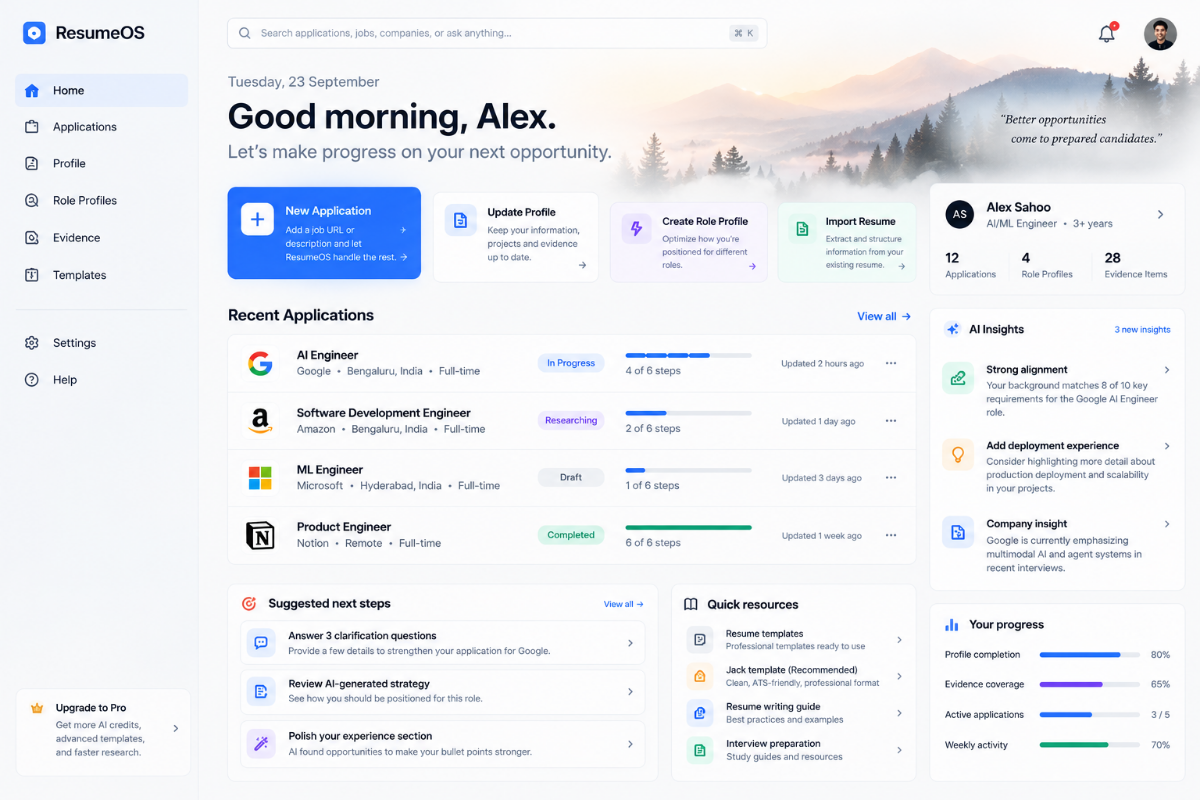
ResumeOS ResumeOS is an AI-native personal job-application intelligence system designed to turn the fragmented resume-building process into a persistent, context-aware workflow. Instead of starting from a blank resume for every application, ResumeOS maintains a structured understanding of the candidate's professional experience, evidence, skills, projects, achievements, and target roles. When a user provides a job posting, ResumeOS: 1. Analyzes the opportunity and extracts structured job intelligence 2. Understands the candidate's existing profile and evidence 3. Matches relevant experience to job requirements 4. Identifies missing or ambiguous information 5. Asks only the highest-value clarification questions 6. Develops an application-specific resume strategy 7. Generates structured resume changes 8. Lets the user review and modify those changes in an interactive canvas 9. Preserves every meaningful version and user edit 10. Exports the final resume into the target document format The Core Idea ResumeOS is not a prompt-to-resume generator. It is built around a persistent intelligence layer connecting: Candidate → Evidence → Job → Strategy → Resume → Application The candidate profile remains the source of truth while resumes are treated as job-specific projections of that information. AI Architecture The system uses a bounded agent architecture rather than giving a single LLM unrestricted control. Specialized capabilities handle: - Job Intelligence - Candidate Intelligence - Research - Evidence Matching - Gap Analysis - Resume Strategy - Resume Writing - Resume Critique Agents produce structured proposals rather than directly mutating authoritative application state. The architecture follows: Agent → Structured Proposal → Validation → Domain Command → Persistent State This keeps AI reasoning powerful while keeping application state deterministic and auditable. Evidence-First Resume Generation Every important candidate claim should be grounded in actual evidence. ResumeOS separates: - Candidate facts - Supporting evidence - External research - Job requirements - Resume strategy - Generated content This allows the system to improve wording and relevance without inventing experience, technologies, achievements, responsibilities, or metrics. Structured Resume IR A major architectural component is the Resume Intermediate Representation. The resume is represented as structured semantic data rather than treating DOCX, HTML, Markdown, or generated prose as the source of truth. This enables: - Stable resume block identities - Structured AI patches - Version history - Conflict detection - Reversible changes - Interactive editing - Multiple rendering targets The pipeline becomes: Resume Intelligence → Resume IR → Structured Patches → User Review → Resume Version → Document Export Human + AI Collaboration ResumeOS is designed around collaborative editing rather than autonomous document replacement. AI suggestions are presented as proposals. Users can: - inspect changes - understand why a change was proposed - accept or reject suggestions - manually edit content - compare versions - restore previous versions - continue iterating through contextual conversation User edits always take precedence over generated suggestions. Why ResumeOS The deeper goal is not to build another resume builder. It is to create a reusable candidate intelligence layer that can eventually power: - Resumes - Cover letters - Portfolio content - Project case studies - Interview preparation - Application answers - Career intelligence The first product is a resume workflow. The underlying system is a personal Career/Application OS.