A Habit Tracker That Respects You: Introducing Rite
By Soumya Ranjan Sahoo · · 6 min read
#Habit Tracker#AI coach#Productivity
Most habit apps make you feel bad when you slip. Rite tracks your daily rituals, uncovers patterns you can’t see yourself, and explains them plainly—without judgment, guilt trips, or ads. Here is why we built Rite differently.
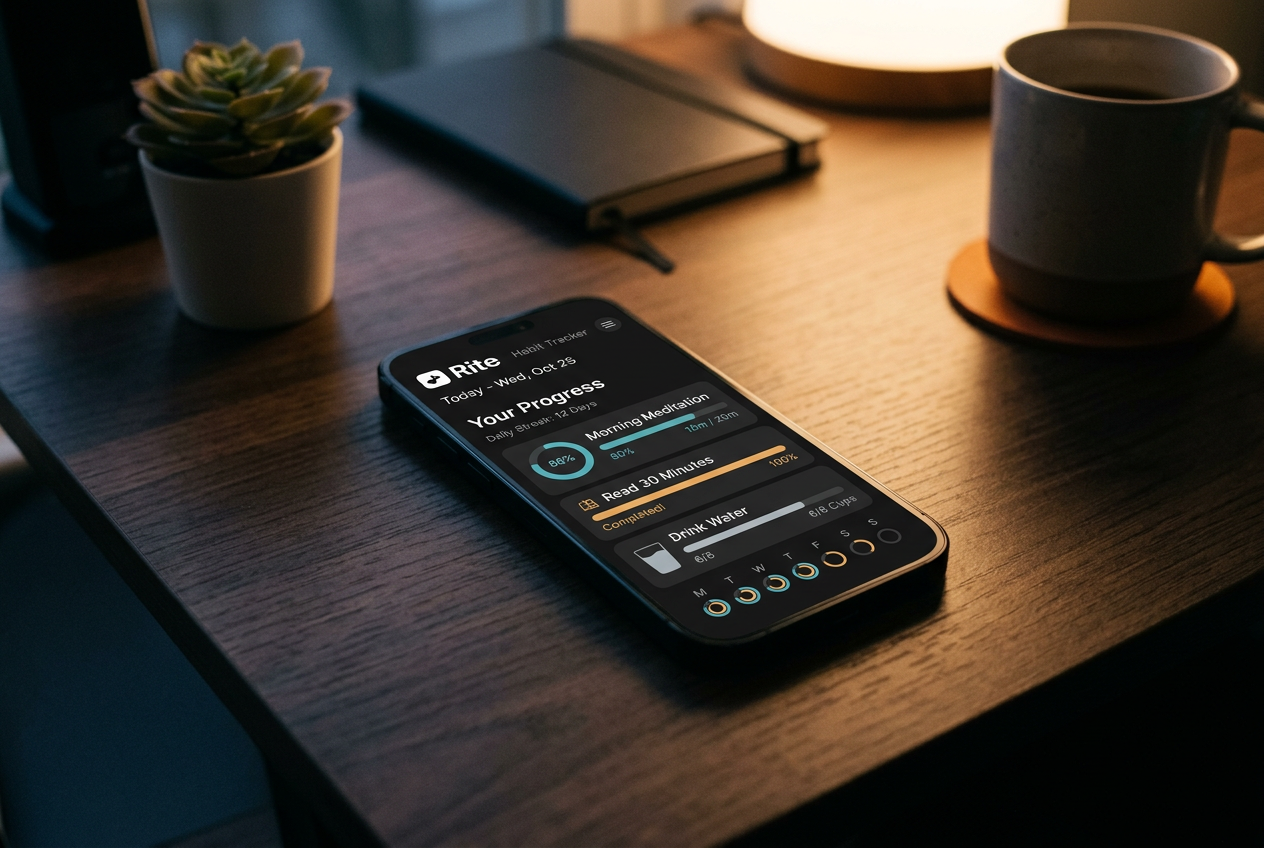
We Built a Habit Tracker That Doesn't Guilt You Into Consistency It's 11 p.m. You've had a brutal week — a sick kid, a deadline that ate your weekend, four hours of sleep on average. You open your habit tracker out of habit more than hope, and it greets you with a red banner: "You're about to lose your 47-day streak!" Underneath it, an ad for a mattress company loads before the button to check off "Drink water" even renders. You didn't fail. You just had a week. But the app doesn't know the difference, and it's not built to care. The Principle We Built Rite Around Most habit apps are engineered around a single lever: fear of loss. Aggressive streak-warning notifications, ads wedged into every screen, and a hard reset to zero the moment you take a day you needed. It works, in the narrow sense that fear is a reliable motivator — right up until it isn't, and the person quietly deletes the app instead of admitting the streak broke. We built Rite on the opposite premise: a habit tracker should celebrate with you, not judge you. Not as a tagline — as the filter every design decision had to pass through. The Version We Didn't Build It's worth naming the default playbook, because Rite is a direct rejection of it, feature by feature. The industry-standard habit app treats consistency as something to be extracted through pressure: a notification that frames a missed day as a countdown to loss, a progress bar that resets to zero with no memory of the 46 days before it, and a business model that needs your attention on an ad slot more than it needs your ritual completed. Most apps optimize for the notification that gets you to open the app today. Rite optimizes for the ritual that's still standing in a year. That's a fine model for engagement metrics. It's a bad model for behavior change, because it treats a missed day as a moral failure instead of what it almost always is — a busy week, a bad night's sleep, a life that doesn't run on an app's schedule. What We Built Instead An AI Coach That Explains Your Data, Not One That Cheerleads Rite is the first habit tracker that explains your data instead of just displaying raw charts. Most apps show you a graph and leave you to interpret it. Rite's AI coach analyzes anonymized completion patterns and tells you what's actually there: > "You complete your exercise ritual 73% more often on days after 7+ hours of sleep." You can also ask it direct questions — "Why does my streak keep breaking on Thursdays?", "Which ritual should I focus on this week?", "What's my most consistent time of day?" — and it answers with specific numbers pulled from your own history. It doesn't boss you around. It presents the facts and lets you decide, which is a very different relationship than a generic motivational push notification pretending to know you. Designed for Quiet Focus, Not Anxiety Most apps escalate the moment you're at risk of missing something. Rite does the opposite. There are no fear-based notifications — full stop. If you miss a day, Rite quietly grants an automatic streak freeze (one per week) before your count zeroes out, so a single rough day doesn't erase weeks of real progress. Finish every morning ritual and the section doesn't just check off — it collapses smoothly into a clean "Morning done" state, a quiet confirmation instead of a confetti demand for attention. Rituals group by morning, afternoon, or evening, and reordering them is a long-press-and-drag away. Privacy as a Feature, Not Fine Print Your habit names, personal notes, and daily history stay on your device. When the AI Coach runs, it receives only anonymized numerical patterns — completion rates, streak lengths, time of day — never your personal habit titles or notes. Nothing is sold, and nothing is profiled for advertising. That last part matters because it's a real constraint on the business model, not a line in a privacy policy nobody reads. No Ads, Offline-First Rite loads instantly on the first frame because your data lives on your phone first, not on a server it has to round-trip to. There are zero ads — not a limited-time promise, a structural one, because the free tier isn't subsidized by attention it sells to someone else. The Rest of the Kit Ritual tracking grouped by time of day with GitHub-style visual calendar views. Smart reminders with inline "Done" or snooze actions right from the notification tray. Timer mode with overtime support for duration-based rituals. Home screen widgets to check off rituals without opening the app. One-tap mood check-ins that feed directly into the AI insights. Milestones at 7, 30, 100, and 365 days, with five accent color themes to make the app feel like yours. The Honest Counterpoint None of this means forgiving design is automatically better design, and it's worth being straight about the trade-off. Some friction is genuinely useful — a certain amount of "don't break the chain" pressure is exactly why streaks work as a behavior-change mechanic in the first place. Strip out every consequence and you risk building a habit tracker that's pleasant to use and does nothing to actually change behavior, which is its own kind of failure, just a quieter one. We think the automatic streak freeze threads this reasonably well — it forgives one bad day a week, not every day — but it's a bet, not a proven law. It's also fair to note the free tier (seven active rituals, five AI Coach messages a week) exists because the AI Coach costs real money to run per query, and "unlimited everything for free" isn't a sustainable answer to "no ads, no data sold." We'd rather be upfront about that tension than pretend it isn't there. The Rule of Thumb If you're designing anything meant to support a habit — an app, a coaching program, a system for your own life — here's the test we kept coming back to: design for the person's worst week, not their best one. A feature that only feels good when things are already going well isn't support. It's decoration. Where That Leaves Us Building sustainable habits takes time, and the tools meant to help shouldn't be the reason it feels harder than it needs to be. Rite is our attempt at a habit tracker that stays out of your way on the good weeks and doesn't pile on during the bad ones. Download Rite on Google Play →