Single-Agent vs. Multi-Agent AI Systems: What I Learned Building Both
By Soumya Ranjan Sahoo · · 9 min read
#Agent Swarms#LangGraph#CrewAI#Multi-Agent Systems#AI Architecture
I rebuilt a single overloaded AI agent into a swarm of specialists and watched it get more resilient — and smarter. Here's why I think decomposed, cooperating agents beat one model trying to hold an entire problem in its head, and where the orchestration pain is real.
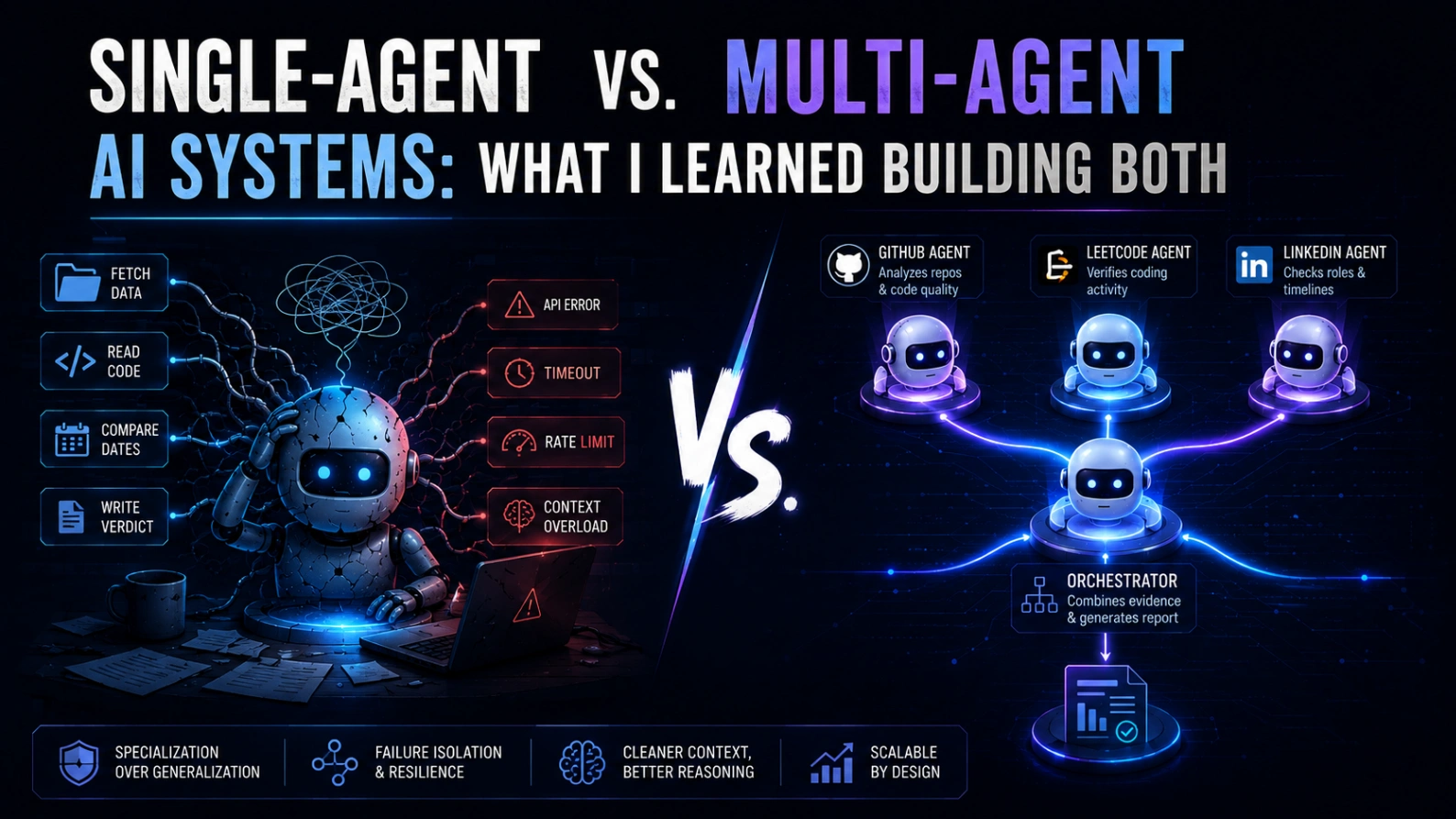
Single-Agent vs. Multi-Agent AI Systems: What I Learned Building Both A few months ago, I was debugging a single LLM agent that was supposed to do one job: read a candidate's GitHub, cross-check it against their resume, and flag inconsistencies. Simple enough on paper. In practice, the agent was juggling five different responsibilities inside one prompt — fetching data, reasoning about code quality, comparing dates, writing a verdict, and handling its own errors when an API call failed. Every time I improved one part of its behavior, something else quietly broke. The agent wasn't dumb. It was just overloaded. That was the moment I stopped trying to build one smarter agent and started building several smaller, dumber ones that talk to each other. This post is about why that shift — from single-agent to multi-agent "swarm" architectures — isn't just a trend I'm following. It's a bet I'm actively building my projects around, and I want to walk through the reasoning, the trade-offs, and the places where I think the hype gets ahead of the engineering. --- The Single-Agent Ceiling Single-agent systems are deceptively easy to fall in love with. You write one system prompt, give it a handful of tools, and watch it reason its way through a task. For demos, this is magic. For production, it's a liability. Here's the problem: as you add more responsibility to a single agent, you're not just adding more instructions — you're adding more ways for it to fail. A single agent juggling retrieval, reasoning, formatting, and error recovery has to hold all of that context in one place, decide what matters at every step, and never lose the thread. The bigger the job, the more brittle that single thread becomes. I saw this firsthand while building CIS (Candidate Intelligence System) — a tool meant to verify whether a candidate's claimed skills actually show up in their GitHub activity, LeetCode history, and LinkedIn profile. My first instinct was to build one agent that did all of it. It worked — until it didn't. The moment GitHub's API rate-limited me mid-reasoning, the agent's entire chain of thought collapsed, because error handling wasn't a separate concern — it was tangled into the same context as the actual analysis. That's the single-agent ceiling: one agent, one context window, one point of failure. --- What Changes With a Swarm A swarm isn't just "more agents." It's a deliberate decision to split a complex problem into narrow, specialized roles — each with its own context, its own job, and its own failure boundary — and let them coordinate. When I rebuilt CIS as a multi-agent system using LangGraph, the difference wasn't subtle: - A GitHub agent only worries about pulling and interpreting commit history and repo quality - A LeetCode agent only worries about verifying claimed problem-solving activity - A LinkedIn agent only worries about cross-referencing claimed roles and timelines - An orchestrator only worries about combining their outputs into a final evidence report None of these agents need to understand the whole problem. Each one just needs to be really good at one narrow thing, and trust that the orchestrator will stitch the pieces together. When the GitHub API rate-limited me this time, exactly one agent failed — and it failed in isolation, without dragging the rest of the analysis down with it. This is the core argument for swarms: specialization beats generalization, the same way it does in human teams. You don't ask one engineer to be your backend developer, your QA tester, and your product manager simultaneously and expect great output from all three roles at once. You hire three people who are each excellent at one thing. --- It's Not Just Resilience — It's Better Reasoning The failure-isolation benefit is the obvious one. The less obvious benefit is that swarms actually reason better than single agents on complex tasks, and there's a simple reason why: context pollution. Every additional responsibility you stuff into a single agent's prompt is more noise competing for the model's attention at every reasoning step. A single agent trying to fetch data, evaluate it, and format a final answer is constantly switching cognitive gears within the same context — and LLMs, like humans, get worse at every individual task the more unrelated tasks they're juggling at once. When I split a task across agents, each one operates in a clean, narrow context window with nothing irrelevant to distract it. The GitHub agent doesn't need to know how to format a final report. It just needs to be excellent at one thing: reading repos and forming an honest judgment about code quality. That focus shows up directly in the quality of its output. I noticed the same pattern building NIGHTSHIFT, my autonomous job-application agent. Early on, one agent handled everything — reading job descriptions, customizing the resume, filling out forms, and recovering from broken page layouts with Playwright. It was unreliable in exactly the way you'd expect: great at the easy cases, completely lost the moment something unusual happened, because "noticing something unusual" was competing for attention with three other jobs at once. Splitting that into a parsing agent, a form-filling agent, and a recovery agent that only activates when something breaks didn't just make the system more robust — it made each individual agent noticeably smarter at its job, because that was now the only job it had to think about. --- The Part Nobody Talks About: Orchestration Is Genuinely Hard I want to be honest about the cost here, because a lot of swarm-hype content conveniently skips this part. Multi-agent systems trade one hard problem (an overloaded single agent) for a different hard problem: coordination. The moment you have multiple agents, you have to answer questions a single-agent system never forces you to confront: - Who talks to whom, and in what order? - What happens when two agents disagree? - How do you prevent one agent's hallucination from poisoning the next agent's input? - How do you debug a failure when it could be happening in any of five places at once? This is where tools like LangGraph and CrewAI earn their keep — but they don't solve the problem for you, they just give you a framework to think about it more clearly. LangGraph's explicit state graphs forced me to actually draw out how information flows between my agents before writing a line of orchestration code. CrewAI's role-based abstraction was faster to prototype with, but I found it harder to debug once things got complex — there's a real trade-off between how quickly you can stand up a swarm and how much control you have once something inside it goes sideways. Running my own local lab with Ollama, LangGraph, CrewAI, and ChromaDB, I've come to a personal rule of thumb: if I can't draw the agent communication flow on a whiteboard in under a minute, the swarm is already too complicated. Complexity in orchestration compounds fast, and it's the single biggest reason multi-agent systems fail in practice — not because the agents are bad, but because nobody designed how they were supposed to cooperate. --- So When Does a Swarm Actually Make Sense? I don't think "agent swarm" is the right answer to every problem, and I'd be skeptical of anyone who tells you it is. Here's the honest line I draw, based on what's actually held up across my own projects: Use a single agent when: - The task has one clear objective with a narrow, well-defined set of steps - Speed and simplicity matter more than resilience - You can reasonably hold the entire task's logic in one prompt without it feeling cramped Use a swarm when: - The task naturally splits into distinct sub-skills (research vs. analysis vs. formatting, for example) - Different parts of the task have very different failure modes, and you don't want one to take down the rest - You're willing to invest real design time into orchestration — not just throw more agents at the problem and hope coordination figures itself out That second condition is the one people skip. A swarm built without a clear coordination strategy isn't more capable than a single agent — it's just a single point of failure with extra steps and a higher API bill. --- Where I Think This Is Heading The more agentic systems I build, the more I think the future doesn't belong to one model getting smarter — it belongs to many smaller models getting better at cooperating. That mirrors something we already learned the hard way in distributed systems and microservices: monoliths are easier to start with, but they don't scale gracefully, and the teams that decompose responsibility early end up with systems that fail more gracefully and improve more independently. Agent swarms are still messy. The tooling is young, the debugging story is genuinely painful right now, and the orchestration overhead is real. But every time I've taken a struggling single agent and broken it into specialists with a clear coordination layer, the result has been more resilient, more debuggable, and — somewhat to my own surprise — smarter at the actual task, simply because each piece finally had room to focus. That's the bet. Not that swarms are easier — they're not. But that decomposed, specialized, cooperating agents are a more honest match for how complex problems actually work than asking one model to hold the whole problem in its head at once. I'm still learning this as I build it, not lecturing from some finished playbook. If you're experimenting with multi-agent systems too, I'd genuinely like to hear what's breaking for you — because right now, that's the most interesting part of this whole space.