Why System Design Should Be Learned Through Simulation, Not Just Theory
By Soumya Ranjan Sahoo · · 3 min read
#System Design#Architecture#Engineering
Traditional system design learning relies heavily on articles and videos. Discover how simulation-based learning helps engineers understand scalability, reliability, and architecture trade-offs through hands-on experience.
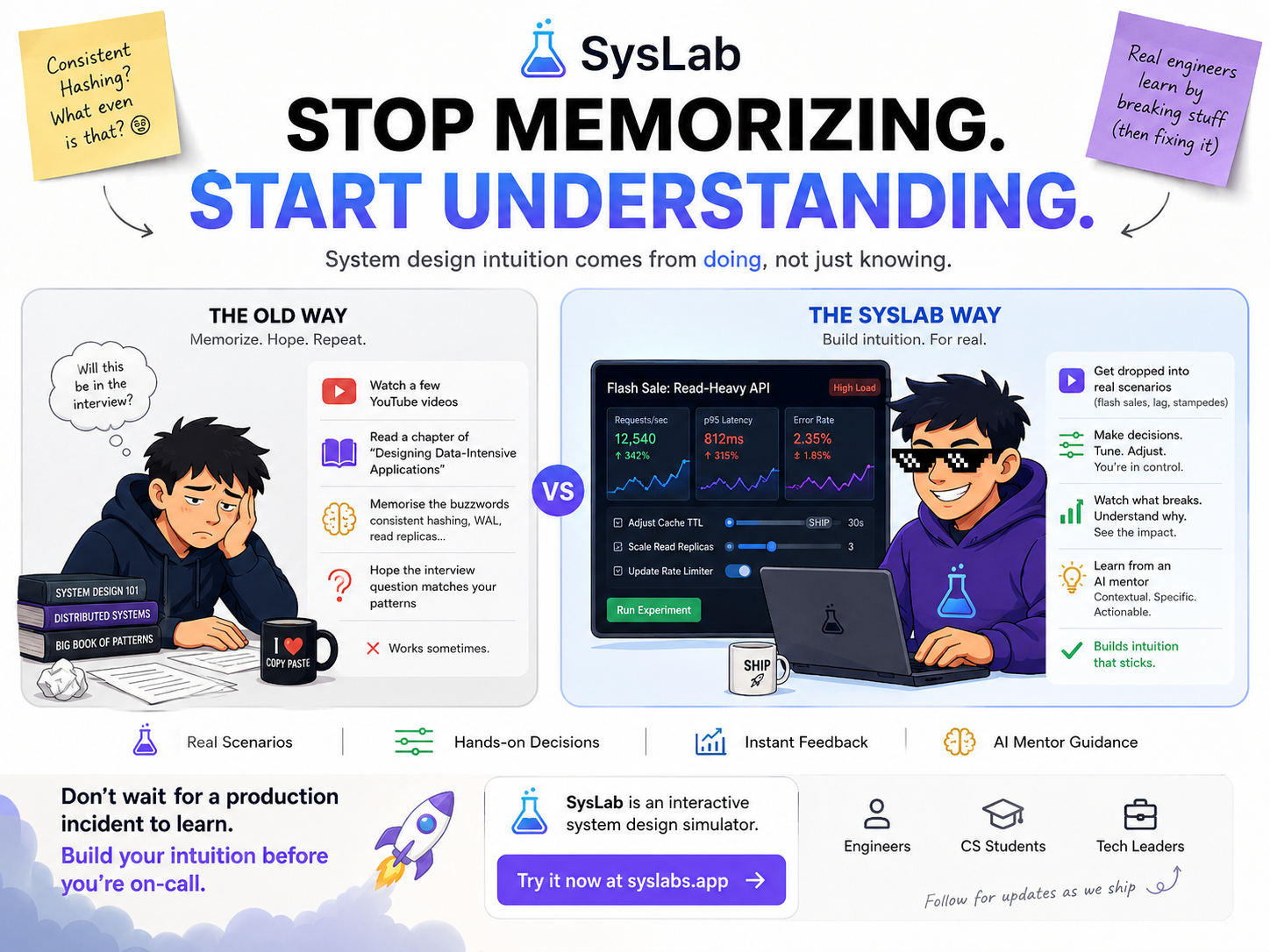
Why System Design Should Be Learned Through Simulation, Not Just Theory System design is one of the most valuable skills for modern software engineers. Whether you're preparing for technical interviews, designing production systems, or building scalable applications, understanding architecture is essential. However, most people learn system design through: - Articles - Documentation - YouTube videos - Whiteboard diagrams While these resources are useful, they often fail to answer the most important question: > What actually happens when your design faces real-world traffic, failures, and scaling challenges? The Problem with Traditional Learning Most educational resources teach architecture concepts in a static format. You learn about: - Load balancers - Databases - Caching - Message queues - Microservices But learning about components is very different from understanding how they interact under real conditions. Many engineers can explain what Redis does but struggle to decide: - When should caching be introduced? - What happens if the cache fails? - How much load can a database handle? - Which bottleneck appears first? These decisions come from experience. Learning by Building Imagine learning to drive by only reading books. You might understand traffic rules, but you wouldn't truly know how to drive. System design works the same way. The fastest way to learn architecture is by: 1. Designing systems. 2. Testing assumptions. 3. Simulating workloads. 4. Analyzing failures. 5. Iterating on solutions. This process develops engineering intuition. The Power of Simulations Simulation-based learning allows engineers to experiment safely. For example, when designing a URL shortener: - What happens at 1,000 requests per second? - What happens at 100,000 requests per second? - When does the database become a bottleneck? - How much improvement does caching provide? Instead of memorizing answers, engineers discover them. Understanding Trade-Offs Every architectural decision involves trade-offs. Adding caching improves performance but increases complexity. Introducing microservices improves scalability but creates communication challenges. Using eventual consistency improves availability but impacts data freshness. Simulation environments make these trade-offs visible and measurable. Developing Real Engineering Thinking Strong system designers don't memorize architectures. They ask: - What is the bottleneck? - What are the scaling limits? - What happens during failures? - How can reliability be improved? Simulation-based learning encourages this mindset by placing engineers in realistic scenarios where decisions have consequences. Introducing SysLab SysLab was created to transform system design education from passive learning into active experimentation. With SysLab, engineers can: - Build distributed architectures visually. - Simulate realistic workloads. - Analyze performance bottlenecks. - Explore scalability strategies. - Receive AI-powered feedback. - Learn through real-world scenarios. Instead of reading about system design, users experience it. The Future of Technical Learning The future of engineering education is interactive. Just as coding platforms revolutionized programming practice, simulation platforms can revolutionize system design learning. The goal isn't simply to teach concepts. The goal is to help engineers develop the judgment, intuition, and decision-making skills required to build scalable systems in the real world. Final Thoughts Reading articles teaches knowledge. Building systems creates understanding. Simulating real-world scenarios develops expertise. If we want engineers to become better architects, we must move beyond static diagrams and embrace hands-on, simulation-driven learning. That's the vision behind SysLab.